Fire Protection Tier-1 Platform | Building a Smart Fire Protection Unified Management Network for a City
We leverage our proprietary UbOS as the IoT data foundation to build a city-level Tier-1 fire protection platform. The system manages 267 key facilities and more than 300,000 IoT monitoring points across the city, providing a comprehensive digital fire governance platform that significantly enhances regulatory and operational efficiency. In addition, it offers PPP project operators a scientifically designed O&M platform that reduces overall maintenance costs and improves project-level return on investment.
2019
IoT platform development, design consulting, UX/UI design, large-scale IoT-integrated e-government system development, and formulation of fire protection IoT protocols

01 City-level IoT Platform
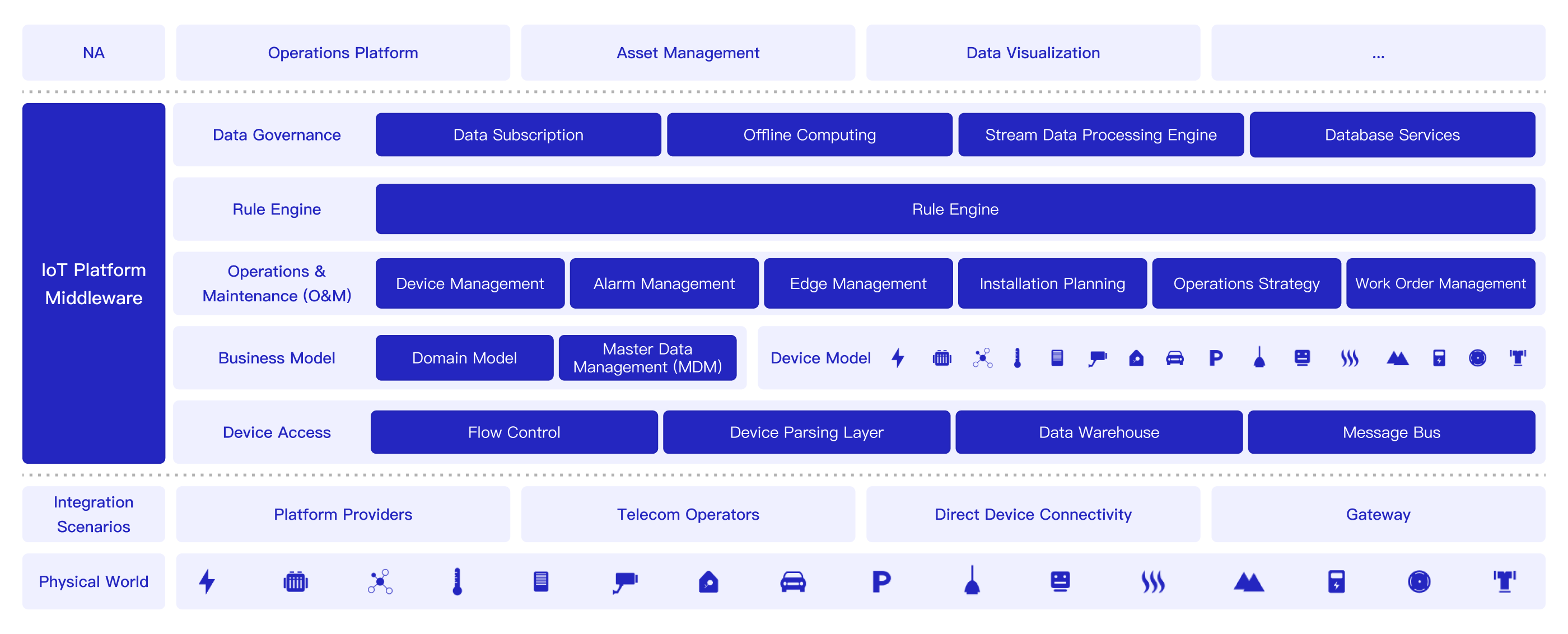
1. Ubos IoT Platform
To address the citywide demand for firefighting equipment connectivity, we leverage the UbOS IoT Platform as the intermediary layer between business systems and sensing devices. It plays a critical bridging role by providing stable and reliable data subscription services to northbound applications, while enabling extensive integration of firefighting equipment and data through internet gateways on the southbound side. This builds a city-level sensing network.
2. Massive Data and Computing Power Optimization
The first phase of the overall project involves connecting over 300,000 access points. This requires compliance with domestic IT innovation standards and private deployment, while the overall computing power costs must meet the operational requirements of PPP projects. To achieve these conditions, we leverage edge algorithms and a scalable architecture design to ensure a stable computing power foundation for massive data.
3. Smart Fire Protection Equipment Protocol Library
For complex scenarios involving 23 major categories of fire protection equipment, each with over five suppliers, we establish a unified data model by defining specifications for each category and designing object models compliant with the smart fire protection system.
Simultaneously, we build protocol translators for over 100 brands of terminal equipment to match their object models, ensuring data consistency for northbound applications.

02 Operational Costs
- 1. Equipment Ledger & Maintenance Support
- 2. Maintenance Models & Smart Work Orders
- 3. Third-Party Maintenance
- To reduce excessive reliance on personnel during repairs, we establish a dedicated equipment ledger for each individual device within the system. This ledger assists both the system and human operators in determining repair strategies upon fault detection. It also provides corresponding after-sales engineering support during equipment maintenance, encompassing circuit diagrams, repair procedure guides, and equipment location maps. This effectively minimizes personnel dependency in the repair process, achieving the goal of reducing labor costs.
- In a key facility, equipment typically exceeds one thousand points. At this scale, a building complex generates daily fault alerts. To effectively control the frequency of field maintenance calls, we establish maintenance models. These models guide which types and characteristics of faults require immediate emergency work orders, while identifying faults that can be addressed during routine inspections. This approach significantly reduces unnecessary high-cost maintenance orders.
- Given the industry characteristics of fire protection and the operational requirements of PPP projects, the system enables third-party maintenance providers to automatically integrate into the fire protection operations framework. Through online contracting and designated fire protection zones, responsibility associations are established, allowing these providers to become work order contractors. This approach achieves the core objective of asset-light PPP project operations.
03 Firefighting Platform
- 1. Tier-1 Fire Safety Platform
- 2. Fire Safety Tier-2 Platform & Community Platform
- 3. Fire Operations Command Center
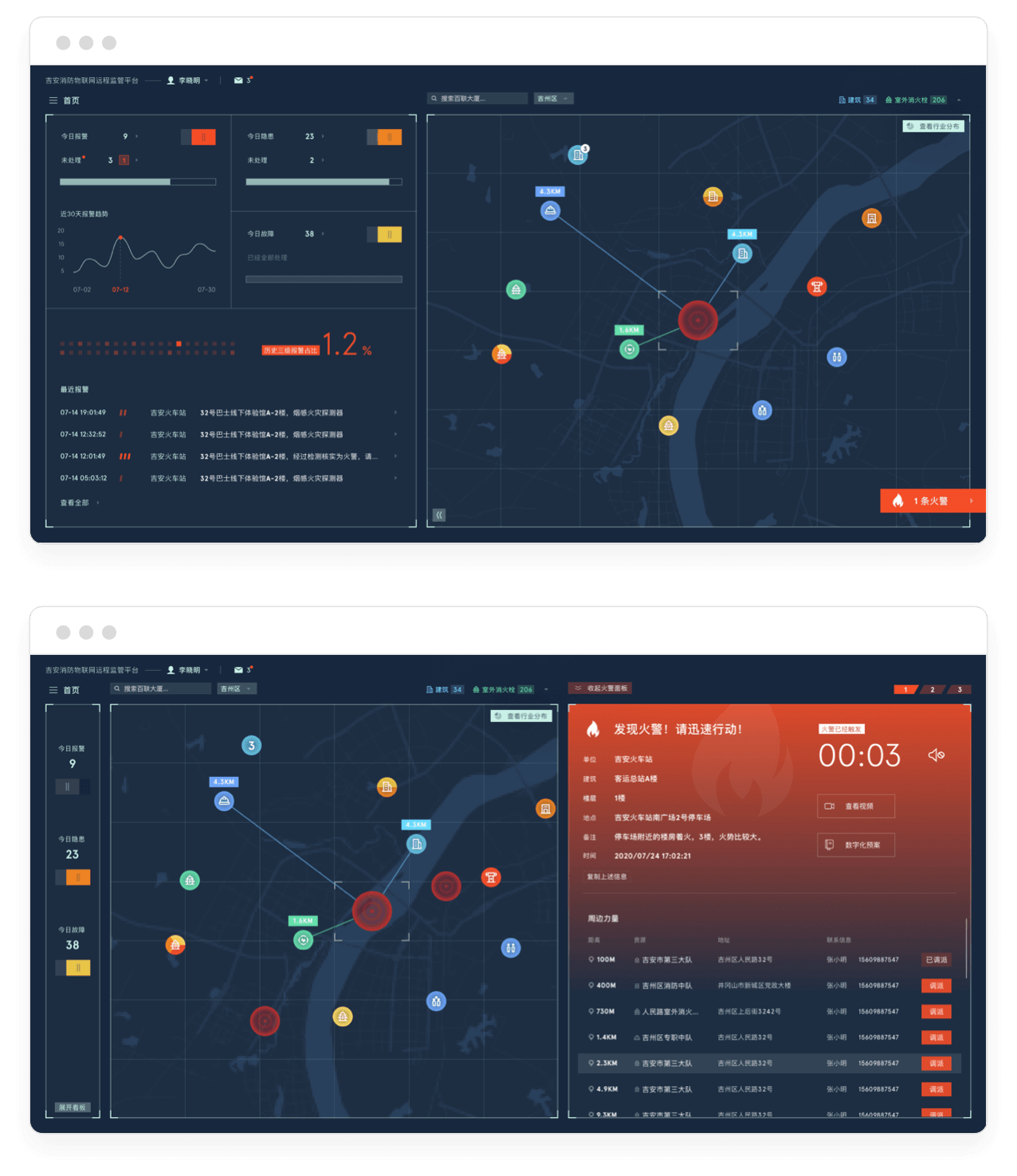
- Guided by the Ministry of Public Security of the People's Republic of China's Directive No. 297, establish a city-level smart fire safety Tier-1 platform compliant with regulatory requirements. Assist in formulating fire safety data protocols and construct a unified network management platform capable of collecting fire safety data from all key facilities across the city. This platform will enable local fire brigades to issue daily fire prevention tasks and directives to each key facility through the system.
- Establish fire safety tier-2 platforms for all district-level departments across the city to assist in managing key facilities within their jurisdictions and relay real-time fire alarm and notification data. Create corresponding community platforms for each key facility to receive fire safety assignments and submit routine maintenance, inspection, and review data, thereby fulfilling the core operational requirement of networked, real-time oversight of fire safety affairs.
- Provides intelligent operational support during firefighting and emergency response, delivering detailed information on firefighting resources surrounding the incident site. This includes critical data such as outdoor hydrant water pressure, fire station equipment status, and water pressure within buildings at the fire scene, thereby offering data-driven decision support for developing effective fire suppression plans.

04 Perception Network Scenario-Based
- 1. Small-Scale Fire Scenarios
- 2. Scenario-Based Collaboration
- 3. Intelligent Algorithms
- To meet the coverage requirements for the “Nine Small Places” fire safety scenarios, we leveraged the deployability of NB-IoT smoke detectors to achieve rapid, citywide deployment across all targeted venues, enabling full municipal coverage of the fire sensing network.
- Leveraging Ubos' cross-brand rule engine, we establish scenario-based collaborative tasks for devices across different brands. For instance, when a smoke detector triggers an alarm, the platform automatically retrieves footage from the camera closest to the detector's location to assess whether it's an actual fire scenario. It captures data from 15 to 60 seconds after the alarm and pushes it to the responsible personnel in the corresponding fire zone, enabling rapid verification of the alarm's validity.
- To effectively utilize data from all cameras, we have established a video aggregation platform that centrally processes data before invoking third-party visual algorithms. This enables fire departments to implement proactive visual detection alerts, such as halting elevator operations when electric vehicles are detected inside, or automatically issuing violation alerts when fire lanes are persistently blocked by delivery vehicles. As algorithms evolve, the platform will continuously support expanded detection capabilities.

